2014年5月4日 星期日

[Reflection] What I Learned

LIX: The World’s Smallest 3D Printing Pen

At the beginning of this class, like everyone else, I was intimidated by using technology regarding all the software and possibly "coding." I considered myself a very traditional artist and I did not anticipate to incorporate digital media in art class besides using basic photography. It was hard to imagine how I would use these new media in a lesson plan. 

However, this class has completely changed my perception on digital media. Although some of the media displayed certain technical challenges, I find the overall course full of pleasant surprises. For example, I would never imagine using scanner, video, and social media to create art. Furthermore, I am surprised by the simple tools that are available online such Audacity for sound art, Scratch for video game, and Moviemaker for video art. These softwares have turned what I perceived to be difficult process into simple exploratory activities that young people would enjoy. 

Throughout the homework assignments I find researching artists and making lesson plans the most helpful. The fact we saved these information on a blog makes it easy to track and reference to after we started teaching. I particularly enjoyed the collaborative project in class because I got to learn from my classmates something I may not be familiar with before I started my own project. 

At the end of the course, I find new media a challenging yet stimulating medium to work with. Lots of it is centered on abstract and conceptual planning which confronts us as problem solvers to brainstorm solutions in order to execute the ideas in our mind. Furthermore, the fact that digital media is so accessible and abundant in currently days makes it a relevant medium to the younger generation. I think I definitely learned a lot from this class. (Thank you Richard!)

2014年5月3日 星期六

[Wearable Design Artist] Ying Gao


Ying Gao is a Canadian based designer who questions public's assumptions about clothing by combining urban design, architecture and multimedia. She is inspired by the social and urban environemnt and through exploring the construction of the garment, she creates these interactive design that incorportates digital technology experimentally. Her inclusion of sensory technologies makes her garment playful and interactive. For Gao, "design is the medium, situated in the technological rather than in the textile realm." Ying Gao explores both the status of the individual, whose physical contours are transformed by external interferences, and the garment’s function as a fragile protective space.


The project was built around the idea of uncertainty. Both garments are activated by the spectator's voice. Through the motion of the pins, the garments engage the spectator on a conversational level, which is filled with misunderstanding(s) and uncertainty.


These interactive pieces play with the public’s perception: the fluid movement of breathing is simulated using sensors and a pneumatic mechanism that’s sown directly onto nylon and cotton. These unconventional garments then take on a playful dimension through their inflatable capacity.


Ying Gao

[Project] Sound Art Revisited


[make up project for wearable design workshop]

After completing my final project, a combination of audio and digital painting, I found sound to be a very interesting medium to work with. Continuing my exploration with classical music, I have combined a recording of my younger brother's piano playing, by which I extracted from a video, to merge it with my own playing the song "Swan Lake" by Tchaikovsky (one of my favorite classical music).

I was inspired by John Cage's 4'33" by which the audience participates in a silent music performance. The gentle noise created by the audience becomes the melody whereas in my piece, the audeince needs to concentrate and sort through the chaos to reach the melody they are familiar with. I intentionally leave the noise in to challenge the listening expereince of classical music (general perception of elegance).


2014年5月2日 星期五

[Reflection] New Media in Classroom

"What's the place of new media in an art classroom?"

I have previously written on the wiki space against using new media in classroom. Over the semester my thought has changed. Right now I support using new media in class but with restrictions: I feel students over 12 years old may enjoy the privilege digital media. 

First of all, developmentally children younger than 12 are still developing their body and it is important to have them engage the whole body through traditional medium (hand eye coordination). Also, younger students tend to play more and distracted more by digital media than older students who are more mature and are able to control. There is a general fear that these digital medias are quite pricy compare to traditional art material so I think all in all it would be better to incorporate digital media starting at middle school.

Digital media allows abstract thinking but at the same time demands more conceptual and logical planning in order to carry out a project. With older students I feel they will be able to practice digital media more effectively and appreciate its benefit. With prior experience on traditional material students will be able to apply what they learned in terms of design and technique and creatively infuses into the digital classroom. Therefore, I support using new media in classroom starting from middle school. 

[Connection] Wearable Design Lesson Plan


Computational Fashion @ Eyebeam
For this lesson, a class of 11th grade students will be visiting Eyebeam Art + Technology Center for a field trip. Students would look at various artists who use digital media creatively as a general introduction, and then participate in a workshop on the theme of Computational Fashion, an Eyebeam initiative bringing together artists, fashion designers, scientists, and technologists to explore emerging ideas and develop new work at the intersection of fashion and technology. Students will have the choice to participate in one of the 3 workshops: 

1) Smart Textiles: Fashion That Responds 

2) "Fashion and the Body" Panel + Wearable Tech Demo

3) Costumes as Game Controllers: The Lightning Bug Game

Students will write a reflective paper on their expereince in the workshop oulinging what they learned and what role and impact does wearable technology play and have in current world? Students will be separated into 3 groups for a short presentation introducing their workshops to others who haven't had the chance to participate.


Computational Fashion

2014年4月24日 星期四

[Final Project] Audio, Drawing/Painting, Identity


http://www.fastswf.com/YfE2Jxc
http://www.shareswf.com/game/35255/nutcracker-march

(either link works fine)

For my final project I have the 3 keywords: audio, drawing/painting, and indentity. I went through a lot of planning and finally decided to challenge myself by doing an all digital project. I started with the idea of "audio visual / music visualization," regarding how we see visuals through melody and rhythm. I find this an important topic to explore because many artists are often inspired by music (Kandinsky, pop art, contemporary). Furthermore, in my field observation I also found out that many adolescents enjoy listening to the music while making art. Thus, I am interested to explore the relation  between these two forms through digital media.

There are many softwares online called the "music/audio visualizer" that people have created to visually represent sound. For me I chose to "map" a music clip that is significant to me. From Tchaikovsky's Nutcracker, "March" to me is the first classical music I recall. Ever since then I have developed great interest in music and have been taking piano classes for 13 years. I debated greatly whether to apply to music or visual arts for undergrad degree. Though I ended up choosing the path of visual art,  music is still very dear and important to me. Through this artwork I want to commemorate my relation with music, that both music and visual art consititute to my identity. 

I used Flash for this project. The idea is that each note corresponds to a particular color: Do (red), Re (orange), Mi (yellow), Fa (green), So (blue), La (indigo), Si (purple). Each paint drop also drops on the location same as the note on the staff. The size also corresponds to the volume of each note. I am not so familiar with Flash so it took me quite a while to figure out the procedure. The hardest part was to coordinate the drops to the music. There are still spots in the final work that don't quite match after rendering but I tried my best. In the end I combined audio and "painting" through a video that I feel best represents me.


2014年4月23日 星期三

[Project] Scratch Mini Game


Dog chasing the ball~ 
Using "up, down, right, left" arrow keys to control the the baseball. Avoid the dog!

2014年4月22日 星期二

[Video Game Artist] Ryota Kuwakubo


Ryota Kuwakubo is a Japanese artist who has created works mainly using electronics since 1998. His works appear to be gadgets but focus on the phenomena that occur on the borderline between digital and analog, human and machine, and information sender and information recipient. His work challenges us to rethink our relationship with electronic devices by combining flawless hardware design with interactivity.

loopScape

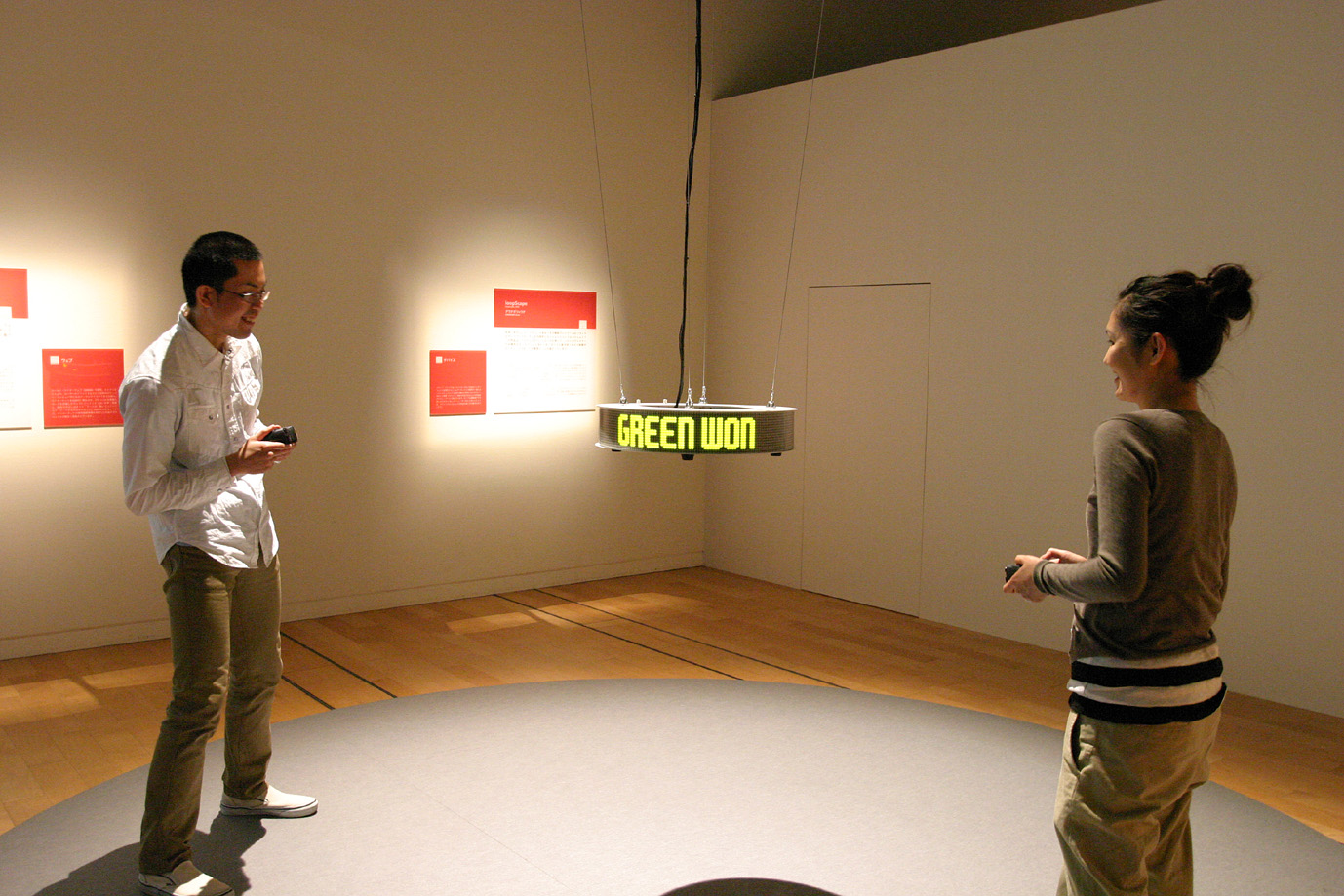
loopScape is a shooting game for 2 players with wireless controllers. However, this artwork appears to be an unusual battle game where two players move around the cylindrical display when they play. The two players can enjoy this game and move their bodies as if they were playing a sport. With a change in thinking that connects "this side" and "the other side," this game changes our perception on conventional battle games.

"PLX"

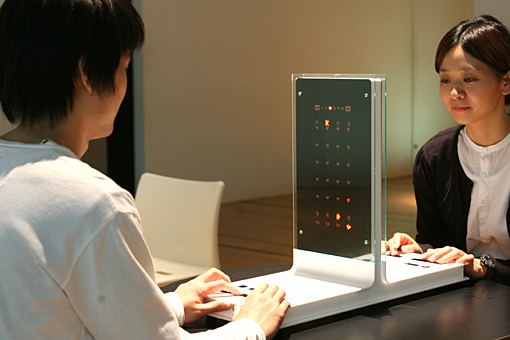
This is a one-on-one battle game in which two players though face to face, play different games based on a shared program. In an one-on-one conversation, people often speak about different subjects though they think they are talking about the same topic. This work expresses these gaps in communication in the form of a game.

[Video Game Artist] Feng Mengbo

Feng Mengbo is one of the pioneer Chinese artists to work video game and digital media as an art form. He combines this with cultural influences of China to produce narrative pieces, full of computer game images, mixed with symbols from communist China. Some of the video games he created with Chinese themes include 'Game Over: The Long March' and 'The War of Resistance against Japan'. 

'Game Over: Taking Tiger Mountain by Strategy'
Digital image from computer game (1994) 

"...I'd rather be considered a game artist than a Political Pop artist...This doesn't mean that I don't care about history, simply that I can't be responsible for it." 

Long March: Restart (2008)

In 2008 he produced Long March: Restart which was featured in MoMA during 2011. It is a large-scale fully functioning and interactive video-game installation. It resembles imagery from classic games like Street Fighter II and Super Mario Bros., along with propaganda motifs from Communist China. Visitors will direct the hero, a Red Army soldier, using a wireless controller to combat the various enemies in his digital path.

I find it very ironic how he transformed video game, usually associated with entertainment, into something so political and loaded with strong messages. It totally makes sense in a way because people do invest much emotion while they're engaging with video game, through the interaction audience also expereince artist's manifestation of emotion and ideas. 

2014年4月17日 星期四

[Project] 100 People Project

For this particular project, I was inspired by the recent phenomenon of people posting photos on facebook and requesting for "likes," in order to gain some personal reward.


I find it interesting as to how many likes this photo could collect from strangers all over the world, reaching 1 million hits. It is amazing that through social media, strangers among the world could participate in the same event and helping strangers to achieve a personal goal. Therefore, for this 100 people project I decided to use social media (Facebook) in similar manner by posting a photo on my facebook wall. Instead of  asking for likes, I asked a question, "what is art?" to my facebook friends and requested them to leave comments on my photo.

I have acquired 114 comments from my friends within just 2 days, which is really unexpected. The answers show a wide range of variety and some answers really surprise me. I have  put together the answers using tagcloud to show which theme is the most predominant. It is not a surprise that "expression" proves to be the most common answer, followed by "emotion."


[Reflection] Working with Smart Material


Heat sensitive fabric: one of my favorite smart materials. 
I find it simple and serves a introduction of technology to students. 


Creating the simple circuit proves not to be so simple as I expected. I enjoyed using the conductive pen. However, my design was not well designed so I had a lot of difficulty making the LED light to light up. Though it was hard, I find it really rewarding the moment the light went on. Technology can be so frustrating at times but it really challenges me and enable me to develop my problem solving skill. 


I really like the video presentation showing different types of smart materials and high technology. It really opens up my mind and promts me to consider the types of technology to introduce to students. The concept of paper as smart material is particularly interesting.

[Project] Designing with Adobe Illustrator


After exploring with Adobe Illustrator in class, I have played with the software at home. I tried to combine different shapes together and this is the animal I came up with. I also played with colors and texture to further enhance my design. I had a lot of fun.

2014年4月11日 星期五

[3D Printing Designer] Iris Van Herpen

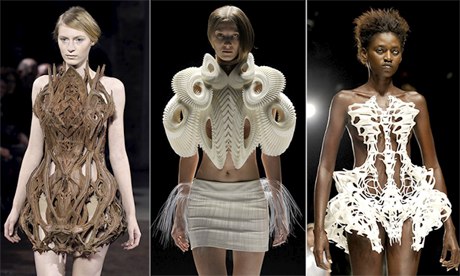
Dutch designer Iris Van Herpen, is one of first to create fashion garment made of 3D printing technique (Spring/Summer 2012 Haute Couture collection show in Paris). Van Herpen collaborated with Materialise and architect to create a 3D printed dress made from lasersintered plastic. She developed a innovative new textile(TPU 92A-1) which is credited as the first printable material that is flexible, durable enough to be worn and washed in the machine. Van Herpen also printed a cape and skirt that are built up out of two totally different materials; one soft and one hard which were printed together. It was the first attempt to combine different materials in a single 3D print. 


3D printing has made it possible to produce precise sizing and mass production. It could also allow startup labels to produce small orders to avoid unsold stock, and allow easy customization. This indicates that there are more possibilities in specifying on flexibility within printing a garment.         


Iris Van Herpen

[3D Printing Artist] Freedom of Creation


Freedom of Creation is a design and research company specialized in design with 3D printing technologies. The Freedom of Creation concept is based on Janne Kyttanen’s project which explored the possibilities of using 3D printing technology and Augmented Reality as viable technologies when changing production and distribution logistics on a global scale. Since the world is becoming ever more digital, decentralized and connected, people will be able to create their own products with great ease. As a result, the value for consumers will increase and waste will decrease. 


First Augmented Reality video by Janne Kyttanen in 2000. This project looked into the possibilities of people being able to upload virtual information into their living rooms and they could then interact with the designs, change certain features in them and when finished, the products could be produced by 3D printing.

FOC Collection includes many exclusive design objects, furnishing complements, lighting and accessories which are all for sale online. 

Macedonia Space Divider
Exclusive Furniture
Trays
Lighting Designs


Freedom of Creation

[Project] 3D Printing Design

Designing 3D printing with Tinkercad:


Designing a 3D sculputre to print is much easier than i expected. The interface is simple and easy to navigate. I designed a cheese under 10 minutes which is unbelievable. I feel this could be an interesting lesson to do with the students in which there are so many potential themes to explore: space, dimension, perspective, relationship between objects, 2D vs. 3D design, from, addtion and subtraction. This also can be combined with other subjects such as math and science.  Although my cheese was incompleted, I ended up liking the texture of it. It is very awarding to see a design come to life in 3D form.

2014年4月9日 星期三

[Connection] Design Lesson Plan

Student:
12th grade, 15 students

Activity:
Student will create an original T-shirt by producing a design that expresses emotions.

Material:
Adobe Illustrator, Adobe Photoshop, vinyl cutter, iron, fabric, baseball cap

Objective:
Student will learn that different combinations of colors and patterns express different emotions. Students will also learn that art and design is closely related and applied in commercial product.


Students will plan color arrangement on Photoshop first to determine their color combination. They will then transfer their choice of colors into a form that they produced on Adobe Illustrator. The design could be abstract, representational, or cartoony. Students at the end would create a runway show exhibiting their design.

[Designer] Duncan Shotton


Duncan Shotton is a young British designer based in Tokyo, Japan.

“My mission is to create products that engage users emotionally, promote happiness and ensure people love what they’re doing, wherever they are and whoever they're there with. My work covers product, packaging, graphic and user interface design.”

Some of Shotton’s design includes Rainbow Pencil, a pencil made from layers of recycled that creates rainbows when it is shaved. His other design, Real Boy Pin, is a Pinocchio-inspired push pins in which the nose serves as the pin. The Cloud Keyholder in which a simple design can evoke humor; the hidden magnets can hold three sets of keys underneath the wall mounted cloud to represent rain.


All of Shotton’s design are simple yet the aesthetics are balanced well with the function and the design shows much personality of the designer. 

Rainbow Pencil

Real Boy Pin

Cloud Keyholder


Duncan Shotton

[Designer] Kobi Levi


Kobi Levi is an Israeli footwear designer who started off by designing unique and creative shoe styles that challenge the standard definitions of design and uploading up to his blog. As his blog grew more popular he received lots of requests leading him to create his own studio that produces limited editions of his designs for sell.


Levi’s shoes are inspired by various everyday themes from animals (elephant, swan, shark), occupations (officer, girl scout, stewardess), hobbits (sing, write, baseball) to whimsical themes such as chewing gum and blond ambition. These designs capture the physical characteristics and the spirit of the subject into the simple form of shoe by carefully selecting and arranging the colors and shapes. The outcome are humorous and original as well as functional. 
ORCA


CHEWING GUM

WRITE


Kobi Levi

2014年3月16日 星期日

[Connection] Sound Art Lesson


What sounds do you hear?

Subject: 11th and 12th grade students
Objective: To have students think about visual vs. audio viewing experience and explore different perspectives of presenting narratives or messages. Students will learn to transcribe their concrete visual data to abstract audio representation.  

1.  Choose a painting you are interested that depicts people (more than two) in a specific background (could be indoor, outdoor, city, or countryside).
2.  Write down what you observed in the painting regarding the activity and the environment. Describe the sound your people might be making or the sound you might hear from the particular environment.
3.  Use a recorder to record and create the sounds you just described. Edit them using audacity to create an “audio narrative” that will re-represent the painting you choose.
4.  Create a small installation with your sound piece. You are free to display anything you want that will complement your audio except the actual painting.


[Reflection] Sound as Artistic Medium


During our in-class project with sound editing I find sound to be a very interesting medium. First of all, it is 3-dimensional and the viewing (or hearing) experience is very different from what we perceived as conventional art medium. Since we focused so much on “visual art” the use of sound really changes our perception. We are left more interpretation and mystery because we can rely on our ears. While we “hear” we are also “looking” for clues and thus engaging our full body.

Sound editing is particularly interesting because unlike visual art where I may be dictated to present a specific image in my mind and worrying about problems such as the composition not coming through and the materials not right, audio art is more experimental and less restricted – it offers unlimited opportunities to play with and it is more fun to manipulate using different methods as well. It can also be combined and presented in various form including recording, installation, performance etc. I think young people will be drawn to sound art because it walks between fine and pop art. It may be more attractive to young people because it has the elements of what they’re interested in: technology and pop culture.


[Sound Artist] Ryoji Ikeda

Ryoji Ikeda is a Japanese sound artist who often works with low frequency sounds and noise, attempting to challenge the definition of sound. He tries to present sound in its pure and raw state and according to him, “a high frequency sound is used that the listener becomes aware of only upon its disappearance" in which I find the quote very interesting. What is it that we hear and how are we experiencing sound. 


Test Pattern is a system that converts any type of data (text, sounds, photos and movies) into barcode patterns and binary patterns of 0s and 1s. Through its application, the project aims to examine the relationship between critical points of device performance and the threshold of human perception.


Ikeda works in various forms such as installation, live performance, publication, concert, and recording. Some of his works involve large scale and interactive component. One of his projects from last year, Test Pattern [100 m version], features a giant indoor space with sound installation and light projection creating a new landscape in which the audience becomes active participant and part of the artwork. It is using technology to challenge traditional viewing experience; instead f silently looking at an artwork on the wall, Ikeda is doing something opposite by adding sounds and making the artwork all around the space. Ikeda has engaged the audience in this new audiovisual viewing experience and the result is quite powerful.


Ryoji Ikeda

[Sound Artist] Yuri Landman

Yuri Landman is a Dutch experimental luthier and musician; he is known for making experimental string instrument for many artists. He was in a band but since he was not classically trained, he started to build his own instruments to play. One of his most famous instruments is the Moodswinger, a twelve-string electric zither with an additional third bridge. He later continued to build more prepared guitar for different musicians such as the Springtime, Home Swinger, Twister guitar, Tafelberg,  Burner guitar, which are all variations based on string instrument (guitar). These instruments make it possible to play every note of the equal tempered scale, and produce multiple notes at the same time. 


Aside from building custom made instruments Landman also began a DIY workshop in 2009 (Home Swinger project) where people will build their copy of the instrument and present a performance afterward. Landman’s instruments are unique because they are designed for specific group and purpose. By adding more strings, though these guitars resemble the appearance of a traditional instrument (guitar, percussion, etc.) they are played differently and can be applied in pop music to create different sound effects appropriate for the stage. These experiemental instruments challenge the boundary of conventional instruments and our perception on the relationship between sound and music.

[Project] Sound Editing


A sound mix of : water dripping, heater, microwave, and eating from a cup

2014年3月10日 星期一

[Project] Scan Art - Sweet & Sour


Materials:
plastic wrap, ketchup, honey, mustard, orange jelly, walnuts, pepper, chicken powder, facial wash, hair cream, and body wash.

I want to play with unconventional materials and therefore I brought in lots of fluid ingredients. I enjoy painting on top of the scanner but in order to protect the machine I have to have plastic wrap beneath which creates rather interseting effects for my imgery. I also played with the setting of the scanner to try different color saturation, contrast, and tones.  

[Project] Revisiting Digital Painting


I really had fun with drawing/painting digitally during last assignment. Last time I was mainly exploring the different effects and textures that I felt my works were incomplete (more like sketches). For this time I wanted to challenge myself to imitate effects of tradtional medium through digital media. I still used tablet but the software has changed to Painter X. I want to create effect of chalk pastel and watercolor and I find working digitally really is a plus because I get to try out different combination on the same surface before I find the right formula. If I were painting/drawing on a piece of paper I will have to plan everything out first or I ended up wasting lots of paper and materials. 

[Connection] Lesson with Scanning


For the lesson of scanography I would like to work with 10th grade student (group of 18). I’ll first start with a dialogue discussing the function and characteristics of a scanner and ask how might students use it. The lesson will be conducted in groups: students will separate into group of 3 and each team will be given a specific task.

Group 1: create an image that demonstrates “movement”
Group 2: create an image that demonstrates “emotion”
Group 3: create an image that demonstrates “relationships”
Group 4: create an image that demonstrates “transformation”
Group 5: create an image that demonstrates “time”
Group 6: create an image that demonstrates “space”

The learning objectives of the lesson is to have the students
1) work collaboratively and learn to communicate with each other
2) explore different possibilities with unconventional material/media
3) begin to think about abstract ideas and ways to represent it visually


The themes I chose are based on adolescents’ development, in which 10th grade students are beginning to make peach with their biological change and are gradually moving towards complex thinking. After creating their images the 6 groups will do a short presentation on their creative process and result. 

2014年3月9日 星期日

[Scan Artist] Rebecca Wild

Rebecca Wild has been working with scan art for several years. The way she creates her work is usually spontaneous and experimental; testing things out repetitively until something unique happens. In one of her projects, Musical Traces, she has experimented with using musical device to bend light and replicate a visual sound wave through scanner. In the other project Abstraction, she tried painting on top of the scanner and allowing the paint to flow freely so that the paint becomes the subject instead the material.


Wild's use of scanner is innovating and the effect she creates displays movement and fluidity. Her work has a tactile quality and through painting on top of scanner the paint (water droplet) creates a surreal effect different from that of digital manipulation. By using scanner as the canvas she makes use of the light (during scanning) to create layers so that her imagery displays a 3D quality.

"Most artists who use a scanner are seen as photographers as they use it as a form of camera but being a painter at heart, I see the scanner as a canvas that can be explored, altered and worked into with the objects I use." -- Rebecca Wild

[Scan Artist] Frank Luna

Frank Luna is a Texas born artist who is originally trained in film editing and is experience in production, video editing and motion graphics.  He has worked on video installations for several museums and forayed into art direction after he moved to New York.


Frank uses human feature as his subject and object to scan. His body images convey mystery and a sense of danger (in which the use of scanner might be harmful to human body). The contrast he creates through color and detail really captures tension and attention that invites the audience to further explore.

The fact that these images show the trace of being pressed against the surface differentiate themselves from photographs makes it even more interesting. With uncompromising intimacy, Luna confronts the eye with pore-gazing glimpses of flattened cheeks, twisted noses, wet pressing lips, and indistinct hollows and curves-only to leave one hanging on the edge of the visible.

2014年3月2日 星期日

[Video Artist] Mariko Mori

Mariko Mori is one the most visible Japanese artists internationally; she works exclusively with sculpture, video and photography installation. Her works often juxtapose Eastern philosophy with Western culture; pop culture with traditional Japanese identity. Through computer-generated photographs and large scale multi-media installations, she merges art and technology to create a dialogue between spirituality and the materialistic world. She also focuses on the topic of harmonious coexistence of man and nature, conflicts between artificial and natural. I find her artistic exploration very interesting as she tries to find balance between technology (mechanic and cold) with that of nature (psychological and organic). 

Journey to Seven Light Bay, Primal Rhythm2011.
Video with sound; 5 minutes, 14 seconds.

"Technology is helping to make a dream realize much easier. Pre-historical people use their hand and other stones to carve an axe, technology, it’s astound to create art. I would really would like children to discover and learn to connect with our nature and express idea through technology." -- Mariko Mori

[Video Artist] Mona Hatoum

Mona Hatoum is a Palestinian artist who works unconventionally with diverse media, including installations, sculpture, video, photography and works on paper. Her work often appears poetic yet delivers strong political messages. Hatoum started her career making visceral video and performance work in the 1980s that focused with great intensity on the body. Since the beginning of the 1990s, her work moved increasingly towards large-scale installations that aim to engage the viewer in conflicting emotions of desire and revulsion, fear and fascination.

 
Corps étranger (1994)
350 x 300 x 300 cm
Video installation with cylindrical wooden structure, 

video projector, video player, amplifier and 4 speakers
      Corps étranger (detail)Photo: Philippe Migeat     


“There is nothing seductive about seeing green slime flowing inside the intestinal tubes, so it is in parts quite disgusting and frightening. For me it was more about issues of surveillance and how we are watched and scrutinized constantly and how our boundaries are constantly invaded.” --Mona Hatoum

[Connection] Collaborative Project with Technology


By doing this group video editing work I realized that technology offers a huge opportunity to work collaboratively. Since it involves a more complex process and technical issue, it is rather time consuming. However, for our group we quickly decided each other’s role in which one member acts, the other responsible for prop, I am the director, and the last member being responsible for editing.

This collaborative process allows students to work together to engage in active communication, to develop problem solving skill, and to learn from each other’s strength. For example, through creating a video project, students first have to come to a unifying theme [communication]. After deciding the plan they will face technical/executing issue and this when they search for solutions through online resources or from peers and teachers [problem solving]. Lastly, each student is unique in his or her ability; a group collaboration like this allows them to learn from each other's skills and concepts that they may apply in the future [learning].

It is also important to note that compares to a collaborative project in traditional medium, technology possess an interesting quality and is more appealing to students. It is new, it is diverse and fun. Technology’s potential is yet to be explored and therefore it offers students various possibilities in terms of different artistic experiences. 

[Project] First Experience with Video Editing

My Inspiration: 

Daffodil flower opening time lapse


My Adaptation:


My approach is based on the concept of flip-page animation. 
Post production with MovieMaker to add title and music.