2014年2月20日 星期四
[Project] Storytelling Through Photographs
I find this assignment very interesting because before I started to look for photos online, I did not have a particular story in mind. I was inspired by the images I found and during the process I gradually developed my story. I particularly enjoy working with slides (http://slideful.com/) because it provides a structure but also allows free interpretation. The tool I use enables me to design and present my story in the effect I want.

2014年2月17日 星期一
[Reflection] Art Teacher's Use of New Media in Class
Using Smartboard
I have contacted
the art teacher I observed last semester regarding how she integrates new media
in her art class. She mentions using smartboard in class to show imagery to the
students because before that, she could only show images with books. Since she
has large classes, books are less effective and engaging for the children. With
smartboard, not only can she show images but during class time she can pull out
information by searching online anytime during class.
Children are always interested in technology and smartboard is able to grab their attention collectively, making it easier to lead a discussion.
2014年2月16日 星期日
[Connection] Photography & Education
I believe what distinguish photography from the
other art mediums is its easy access and simple operation. Anyone can take a
photo by one click on the shutter or using their phone. It is versatile and
allow opportunities to explore without worrying about learning the techniques and creating "realistic" art.
Photography is an excellent starting point for students
who are afraid to draw or paint. Instead of an observational drawing/painting lesson
of nature, by using digital cameras students will first learn to create composition
through the lens. They will experience with observing the big picture first and
then making the decisions to choose which part of their vision that they are
most keen to explore.
Photography is interesting because it exists both
digitally and physically. Students will broaden their art experience by understanding
that the same subject/theme could be presented in multiple ways such as slide
show, video, installation, and prints. Furthermore, these different
presentations could be combined and constructed together to address more complex
issues.
Photography can be manipulated by hand.
Students can alter a photo through computer software or, they can print out the
photos and perform physical manipulation such as drawing, cutting, painting,
folding, thereby creating mixed-media art! Photography for art educator serves
as a good fundamental medium to introduce art to those who are afraid to make
art.
[Photographer] NIR ARIELI
"FROZEN DANCE"
NIR ARIELI started his career as a military
photographer but receives great attention for his project “tension.” This series captures the intensity and graceful movements
of dancers, almost in a X-ray way that even people who cannot dance can feel
the vibration through the photos. Arieli views himself as a visual choreographer and he choreographs these dancers in his pictures by photographing their movements in
several frames and layering them on top of each other to create the breathtaking
effect.
 |
| Ryan |
 |
| Austin |
“Tension was the first project I
came to completely clueless. I never sketched the final image because I really
wanted to get all the possible options … It was much less about a narrative;
it’s about an atmosphere, the dancers’ interpretations to the language I’m asking
them to speak.”
NIR ARIELI
[Photographer] MICHAL MACKU
"SOUl RIPPING"
Michal Macku is a Czech
photographer who developed several techniques to manipulate the outcome of the
film. One of the techniques, termed “Gallage” (the ligature of collage and gelatin), consists of transfer the exposed and fixed photographic emulsion from its original base on paper. This transparent and plastic gelatin substance makes it possible to reshape and reform the original images.
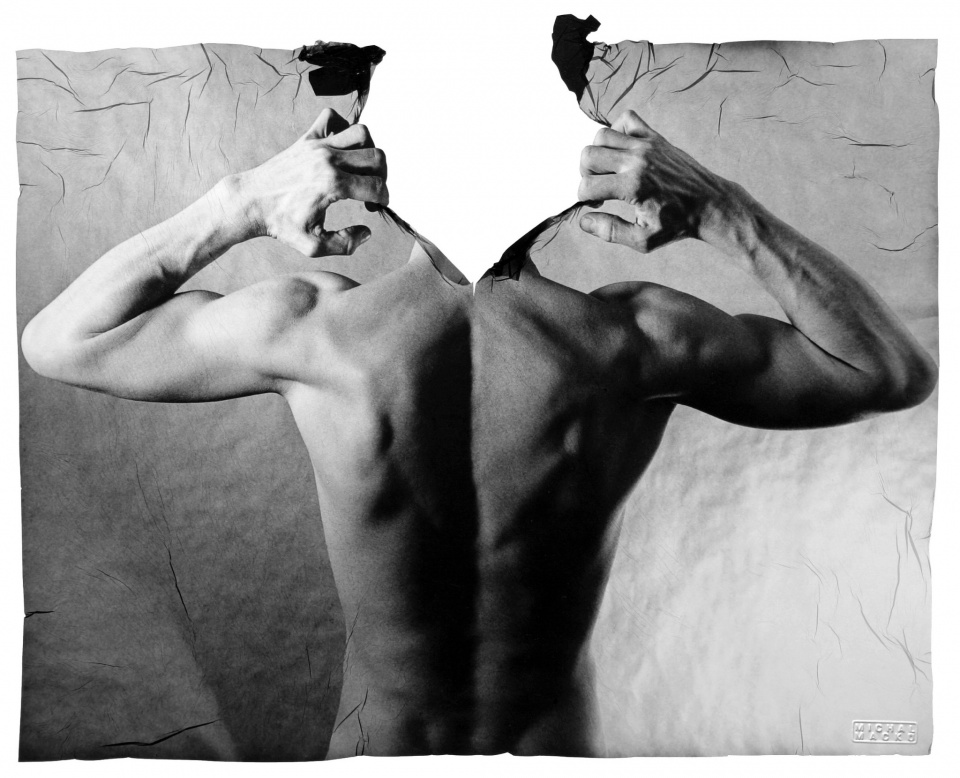
"Photographic pictures mean specific touch with concrete reality for me, one captured level of real time. The technique of Gellage which I am using helps me to take one of these "time sheets" and release a figure, a human body, from it, causing it to depend on time again."

Michal Macku also employed several other techniques such as carbon printing and glass objects. All of these techniques he use expresses a inner struggle and desire to search for freedom. He often uses himeself as the model and I find his body images an innovative and procoative way to connect between self and reality.
Michal Macku
http://www.michal-macku.eu/
http://www.michal-macku.eu/
[Project] Found Photo + Manipulation
 |
| 2013.02.13 Ice Crystals |
For our photography assignment I decided to venture outside and be inspired by the weather (snow storm). I found this wire net located outside my dorm with a sheet of snow crystals on it. I am drawn to its clear aspect in contrast to the muddy snow on the ground. It amazes me how two different things from the same source can end up so differently depending on their environment.
For this photo I would like to respond
digitally in the format of a digital collage or drawing. This picture is a
combination of nature (ice crystals) and manmade (wire net). Yet, the
composition would not be successful without either existence. They depend on
each other: the ice crystals need to survive while the wire net desires
attention. This intimacy reminds me of our relationship with technology. How technology
has become part of this new generation’s life and how much we need
them to display ourselves.
The other theme I'd like to explore is "time." Ice crystals melts in a flash while the wire net remains forever until someone removes it. Yet, we tend to appreciate the beauty of the fleeting over the mundane which is actualy closer to us. Fascination with the "trend" and "beauty" like our addiction to the pop culture is something I'd also like to explore through this photo.
 |
| Wireless |
 |
| Iceless |
Could one survive witout another?
2014年2月8日 星期六
[Project] Digital painting: Serene
 |
| Experiement with Photoshop: Digital Drawing |
This is my expeiementation with different types of brushes and filter effects in Photoshop. The first attempt drawing with tablet.
 |
| Experiement with Photoimpact: Digital Drawing |
My second drawing uses Photoimpact in combination with Photoshop. Instead of pure drawing I was trying to ceate an effect like digital collage with the stamps and patterns.
[Social Media Artist] grahamGrafx //
Graham Smith is a new media artist who studies network science, digital identity, social media, game mechanics, and fine art. He has developed several innovative projects around facebook. One of them is the Facebook Road Trip: mini documentary, by which he went on a 1 week road trip to visit over 100 friends on Facebook in person.
Facebook Roadtrip from grahamGrafx on Vimeo.
He later expanded this project to create Digital Painting: Social Network. On his trip he took people's pulse through their wrist, and a physical souvenir. These pulses were used to create a "digital painting" of lighening bugs. For each Facebook friend there is a lightening bug, and each bug blinks at the same pace as that friend's pulse. The souvenirs were each placed on their own shelf. The heart beat resembles emotional expression and individulaity. The lightning bugs and their pulse represents a desire to connect and find others in virtual space. This project questions that whether digital environments can adequately communicate emotions like that of physical objects which bear significance.
Facebook Roadtrip from grahamGrafx on Vimeo.
He later expanded this project to create Digital Painting: Social Network. On his trip he took people's pulse through their wrist, and a physical souvenir. These pulses were used to create a "digital painting" of lighening bugs. For each Facebook friend there is a lightening bug, and each bug blinks at the same pace as that friend's pulse. The souvenirs were each placed on their own shelf. The heart beat resembles emotional expression and individulaity. The lightning bugs and their pulse represents a desire to connect and find others in virtual space. This project questions that whether digital environments can adequately communicate emotions like that of physical objects which bear significance.
 |
| Digital Painting: Social Network (2009) |
grahamGrafx
[Social Media Artist] an xiao minaAn
An "An Xiao" Mina is an American artist, designer, writer and technologist. In her research and practice, she explores the intersection of networked, creative communities and civic life. Calling memes the "street art of the internet", she looks at the growing role of internet culture and humor in addressing social and political issues in countries like China, Uganda and the United States. She embraces her dual identity as an descent of Filipino and Chinese while growing up in a Latin American neighborhood. Therefore her work often concerns with identity and expression. She takes a multidsciplinary approach, engaging in this area through research and writing, social media art and photography, and design and design strategy.
 |
| The Artist is Kinda Present (2010), photo by James Wagner. |
In the project "the Artist is Kinda Present," An reimagined the piece as a zen meditation exercise. Visitors were provided the following instructions:
Sit down with the artist.This piece examined the nature of contemporary social relationships, which are frequently mediated by digital devices such as cell phones and social media. Many of her works are designed simply yet they trescend powerful impact to the participants as well as to the viewers. We often see each other in person yet that precious bond was disrupted by technology, particulary through social media in which digital connection has overpowered real-life interaction.
Find a comfortable position.
Be present wih the artist in any of the following ways:
A text message to: [PHONE NUMBER]
A tweet to @anxiaostudio.
The artist will respond in kind.
When you have reached a satisfactory connection, or you simply grow bored,
you may leave.
An Xiao Studio


2014年2月3日 星期一
[Project] ON and OFF

I start every day with turning on my laptop
and leaving it there until I turn it off before going to sleep. Whenever I have
to leave a period of time such as for class or going out, I put my laptop on stand by mode. Yet, even after I leave my mind still lingers upon the things I
was working on and I always think whether I missed anything. This is when I get
concerned and I would take out my smartphone and note it down the things I need
to continue or work on after I get back. It is like “post impression,” when I
have images or information acquired from the technology continues to occupy my
mind. There is no actual turning “off” the technology device because the device
serves merely as a medium while the actual information is transferred to the
mind.

The visual I created to represent the on/off experience comes with struggle. At first I really wanted to create something digital but was caught up with the technical issue. In the end I reconsidered about my experience and came up with this simple piece. The container I chose resembles the laptop and when I shut it the clipping sound resembles the sound of bring the laptop lid down. The threads represent my continuing thoughts from what I received from the technology. Despite that the lid is securely shut, information still lingers in my mind and therefore there is really no "off" but an endless cycle of "on" for me.
[Reflection] Every Day I’m Surf-Sliding


I spent an average of 8 hours on my laptop,
the same amount of time I spent on sleeping. I spent the rest of the time other
than sleeping on my smartphone, unconditionally. I don’t know how I “implement”
technology into my life because they are already part of my life. My daily routine starts with waking up and turning on the laptop
to check emails, news, and blogs. Then I turn on the music and start with researching or reading course readings either in PDF format or
in actual books; either way, my laptop is opened and occasionally I chat with
friends over social media or through apps on my smartphone. I carry my
smartphone every day because it contains all the information/tools I need. I
can contact my friends via apps or phone call, take memo, surf the Internet,
listen to the music, and even play games on it if I am bored.
Have I ever think of to use digital technology
for my art practice? Of course, I take photos with digital camera and I manipulate
art through software like Photoshop. But all of these remain to be the “function”
of technology. I will not paint on my laptop like I paint on the canvas;
technology is not “material” for me but it functions like the brush, the “tool.”
I will store my painted canvas carefully and maybe repaint it, but I will not hesitate
to replace my old laptop once it stops working. No matter the history, the tie
I have with digital technology is never deeper and strong enough like that I
have with say, a stuffed animal. Why? There is just not enough personal
attachment to the digital devices I have. Technology for me is not the
“product/result” but the tool. People treasure paintings and put them in a
museum but do they also showcase the brushes used for the paintings? No, but it
would be interesting to challenge myself to think about if it’s possible to
view technology as a product.
[Connection] A Piece of Te[a]ch-nology

When I think of technology I immediately
associate it with digital, functional devices. As a matter of fact, it is
daunting when I realized I have so many pieces of digital technology around me
and they all weight significantly in my life (laptop, smart phone, USB,
charger...) I choose this USB “stick” not for its function as a technology, but
because of its evolution in design. USB sticks have evolved and decreased in
size rapidly; now a day they become chips and come to the size of a fingernail.
With this piece of technology I would like to
challenge my students to think of our aggressive demand for technology. Just
like this USB chip, our desire for newer, faster, smaller, lighter, and thinner
instrument has occupied our life. Students who claim they are unable to pay for
tuition yet they hold the newest smart phone and tablet display people’s
fanatic with “updating.” I would ask my students to
1st: consider the function
of USB, why and how we use it (ex. storing information and
transport it to other places easily).
transport it to other places easily).
2nd: come up with alternative devices
if you cannot use the USB.
3rd: assuming that all of the devices
you provided are unavailable, please design a new
device or brainstorm a new way to transport the information without using digital
technology. Present a visual representation of your idea, it can be in either 2D or 3D
form.
device or brainstorm a new way to transport the information without using digital
technology. Present a visual representation of your idea, it can be in either 2D or 3D
form.
This
lesson will target at high school students around Gr. 11~Gr. 12. The
learning objective is to have them think about the purpose behind using technology
and how we have taken it for granted while we stop updating “ourselves.”
訂閱:
意見 (Atom)